Playtest video
Playtest Information
Build / Version: 3.0.0
Input Method: Xbox controllers (both players)
Additional Player: Non-gamer playtester
Genre Familiarity: Quite familiar. Played Ibb & Obb, DYO and Kalimba
Additional Player Genre Familiarity: None
Previous Knowledge: None
Developer-Requested Focus: None
Content Completed: Full demo
Playtest Context: We had a power outage during Level 4 which resulted in the footage from the first part of the session being lost. Apologies for this, but I could not recover it. I removed the save data and we went back and played Levels 1-4 again for the purpose of the video, but this was therefore not our first playthrough of those levels. In the body of this report I have described our first impressions from those levels regardless. Due to the outage, levels 1-4 in the video are from our second playthrough, and levels 5 and 6 are first-time experiences. I’ve also uploaded the log files given they have some references to errors.
Overall Experience
We had a lot of fun with BIT IT. As I was playing with a non-gamer, I was aware that once a game requires a certain level of dexterity or fast-twitch reactions, it generally isn't an ideal candidate for co-op if it requires too much from a non-gamer. As a result, going into BIT IT blind, I wasn't really sure how easily they would take to it. Instead, they picked it up almost immediately and we spent a lot of the session laughing at our own stupidity and having quite a lot of fun.
At one point during Level 5 we had tears running down our faces because we had died so many times trying to make the very first jump. That was probably the most fun we had during the entire playtest, which I think says quite a lot about how well failure can work within this game.
The fact that we died an awful lot probably makes the game sound considerably harder than it actually is though. The puzzles themselves are extremely easy, and I would put the puzzle difficulty at around 1-2/10 across these six levels. We very rarely struggled to understand what we needed to do. Most of our deaths came from our execution (or lack thereof), particularly some of the more precise jumps that required a certain level of momentum. Importantly, though, death didn't feel frustrating, at least over the course of these six demo levels. Whether that would remain true across thirty-plus levels is obviously something I can't judge from the demo, but during this session neither of us became annoyed by having to repeatedly try again. There is a big difference between repeatedly failing because you don't understand what the game wants from you and failing because of a lack of skill. For us, it was always down to our lack of skill, hence the laughter.
If you asked me whether I wanted to play another two hours immediately after finishing, I would probably say no. That hour felt like enough, and I was fairly content when the demo ended. If you asked whether I would look forward to playing another hour in a few days' time, then yes, I would. The level length feels well suited to jumping in and out for shorter sessions. Assuming there were enough levels and content, I could personally see myself paying somewhere around £1-4 for it. This feels like an ideal candidate for a game regularly discounted to a <£5 price. My colleague also said they would play it with me again as they felt it was building towards something, particularly as Level 6 was their favourite. Given that they are a non-gamer, I think that's quite a positive sign.
Onboarding
Level 1's onboarding was gradual and easy enough that no real explanation was needed. The only thing it really needed to establish was that there would be points where we had to work together. Everything else is fairly standard platforming, but it was introduced at a pace that wasn't overwhelming. I didn't need to explain anything to my colleague. As the non-gamer, they didn’t have the same controller familiarity or understanding of common game conventions as most players probably will, but she was able to pick up the controls and play without me having to instruct her at any point during the demo, which bodes well for the learnability of Bit It.
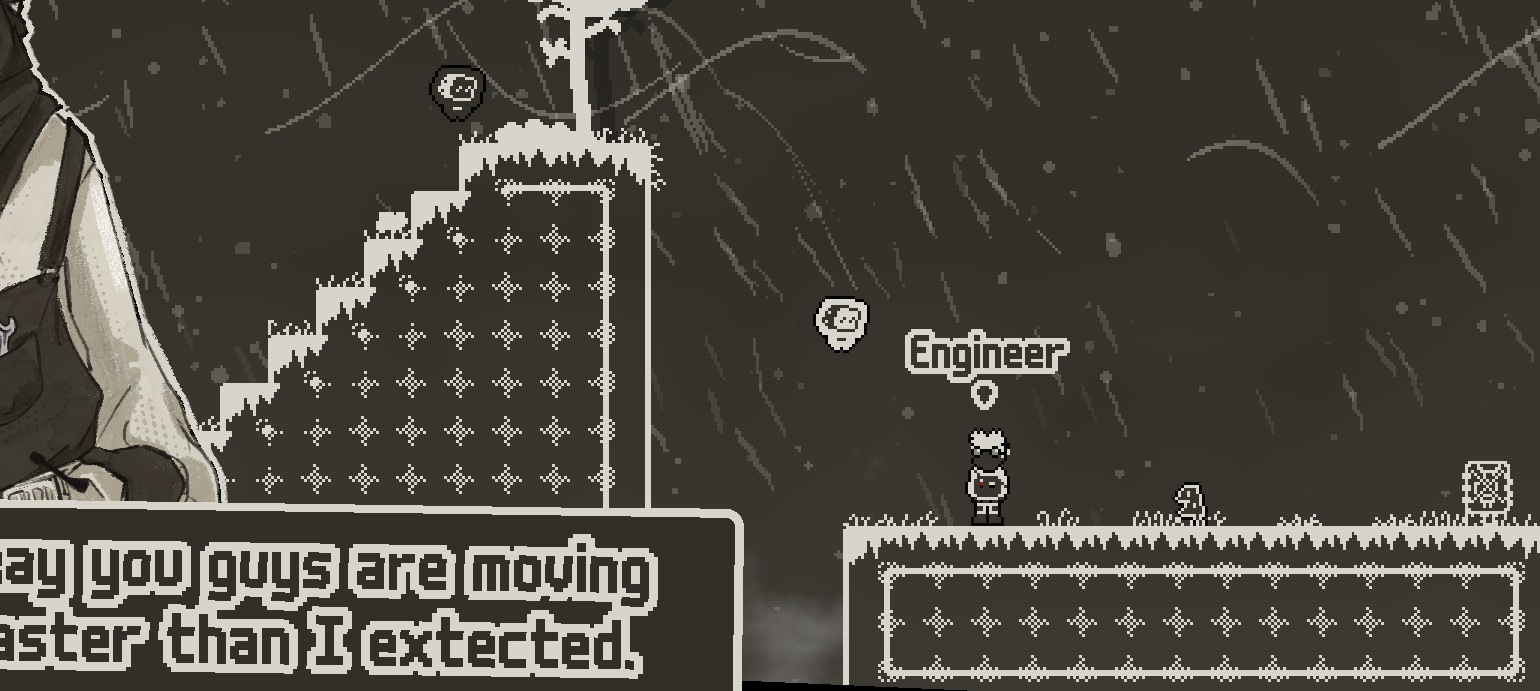
There is one inconsistency with the way Level 1 teaches cooperation. The engineer tells you that a particular sign will be positioned at jumps where you need to work together. That appears to be true in Level 1 and then the sign never appears again. I also don't think the sprite used for the sign communicates its purpose particularly well by itself. If I hadn't been explicitly told what it meant, I don't think I would have understood that it represented teamwork, or necessarily even that it was a sign rather than a safe.
In Level 2, we reached a jump that required us to jump on each other's shoulders but the sign wasn't present. It's very easy to figure out what to do, but the signposting (pun intended) feels inconsistent. If the player is explicitly taught that a particular visual means “you need to work together here”, I think that visual language needs to be used consistently afterwards, but this sign doesn't appear again in the game.
There is also a dialogue trigger during Level 1 that activates while the player is mid-jump. I found that an odd place to take control away from the player, particularly when the game is still introducing movement. If there isn't a specific reason for triggering the dialogue at that exact point, I would move it somewhere that doesn't interrupt an active platforming action.
Co-op
We really enjoyed playing through the demo together, although I think it's important to distinguish where that enjoyment actually came from. Most of the fun wasn't because we were solving particularly deep co-op puzzles. It came from laughing at each other messing up, learning how the movement felt, coordinating jumps, and repeatedly getting the execution wrong. About 99% of the puzzles in the demo have a single layer to them: press a button to make something happen, or use the other player to reach somewhere. I would have liked the demo to give us a little more puzzle depth and show what these mechanics can become when they're combined. I appreciate these are the earlier levels, but they feel a bit shallow. The Steam page looked like it had some awesome platforming that I would have liked to have experienced as a taster.
Level 2 introduces buttons and starts separating the players onto different paths. It's very straightforward, although there is a fairly difficult jump immediately after speaking to the engineer where you don't have much headroom. On our first playthrough we died here quite a lot. I thought that was a nice challenge, though the non-gamer died repeatedly.
Level 3 then introduces changing player size, and this was one of my favourite mechanics in the demo. We both loved the inclusion of role change (so at this point, size change) after every death. One common issue in asymmetric co-op games is that one player can end up with the obviously more interesting role while the other effectively becomes the companion, but you’ve completely removed that here, to great effect. That small touch of swapping responsibility after each death kept it interesting. It keeps both players involved and also means dying can alter how the next attempt feels rather than simply resetting exactly the same situation.
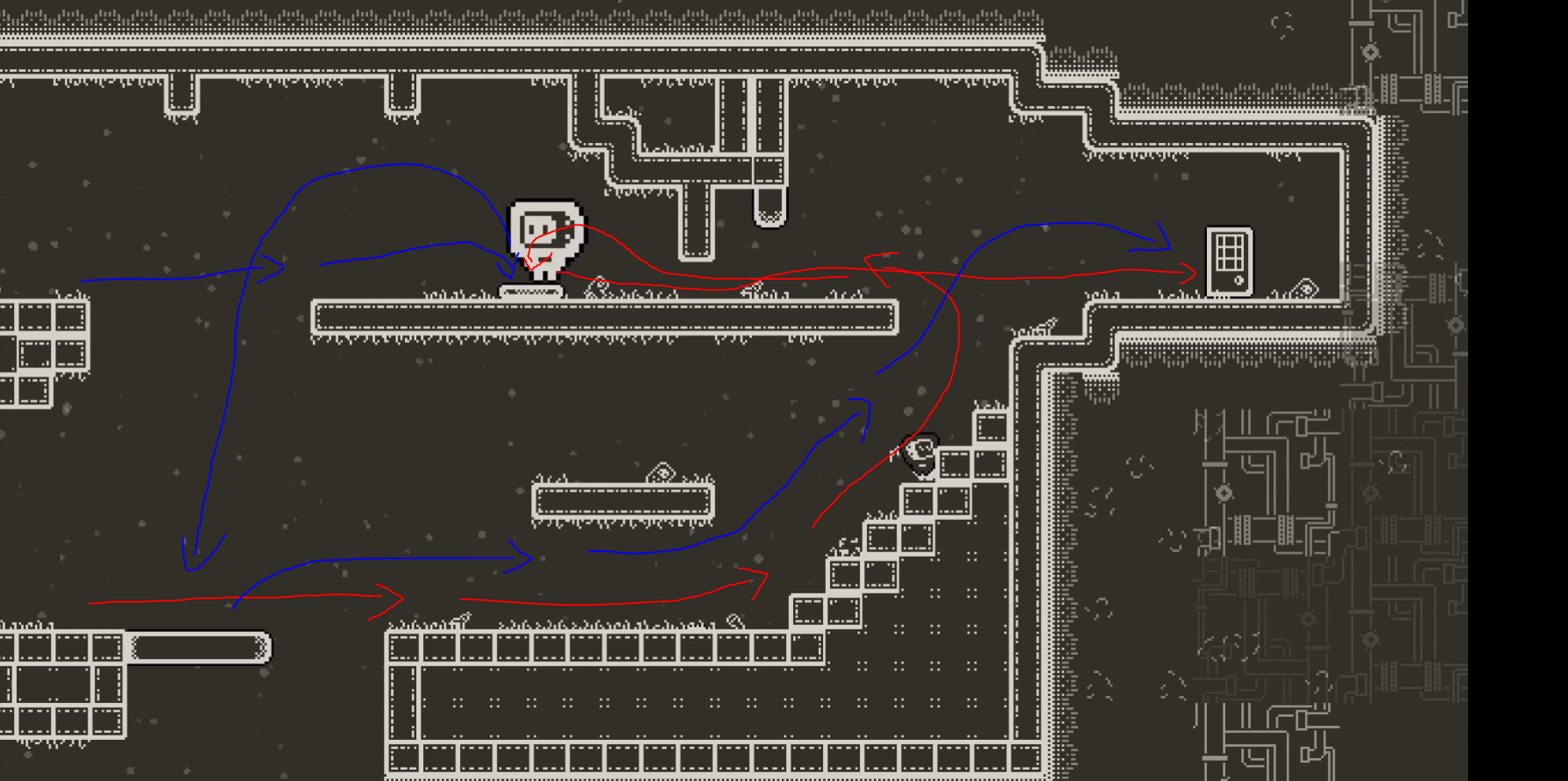
The puzzle at the end of Level 3 was probably the most complex puzzle in the demo, although it was still quite basic. The larger player has to remain on a button so the smaller player can cross a platform and make a jump, then stay there while the smaller player reaches another button, after which the smaller player takes over that role so the larger player can backtrack through the route they have just opened. IMO this is the only puzzle in the demo that has multiple stages. This was one of the only places where I felt we were actually solving something with multiple layers, and I would have liked to see Levels 4, 5 and 6 build further on this. I do understand it's the early game, but as far as a demo goes, it's just that bit emptier than I would have liked to really hook me.
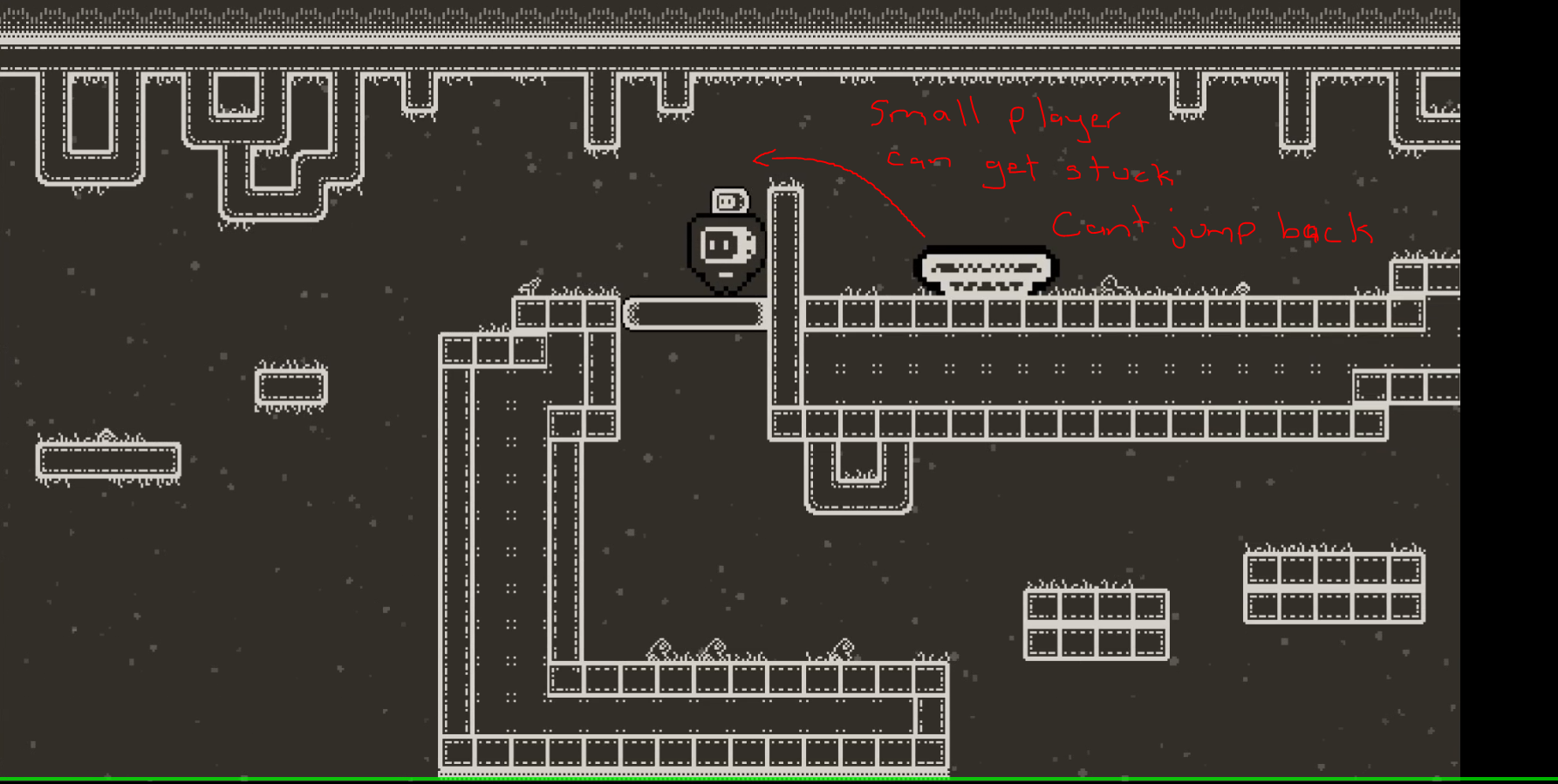
Level 4 then introduces buttons that can only be activated by the larger player. I liked the addition, and on our first playthrough we actually didn't pay enough attention to the size of one of the buttons and we hit a deadlock (one of two we encountered). We sent the smaller player onto it, got that player stuck and had to intentionally die so we could reset and try again. That was a useful way of teaching us that button size mattered, but beyond introducing that mechanic the level was largely a linear walkthrough. It didn't really build on the multi-stage puzzle structure that Level 3 had started to establish.
Level 5 was one of my favourite levels even though it still didn't really increase the puzzle complexity. I particularly liked the button that has a dual purpose, bringing out a platform for the other player while also opening the vertical barrier. That’s a simple interaction, but it makes one action relevant to two parts of the level which was rare in the demo.
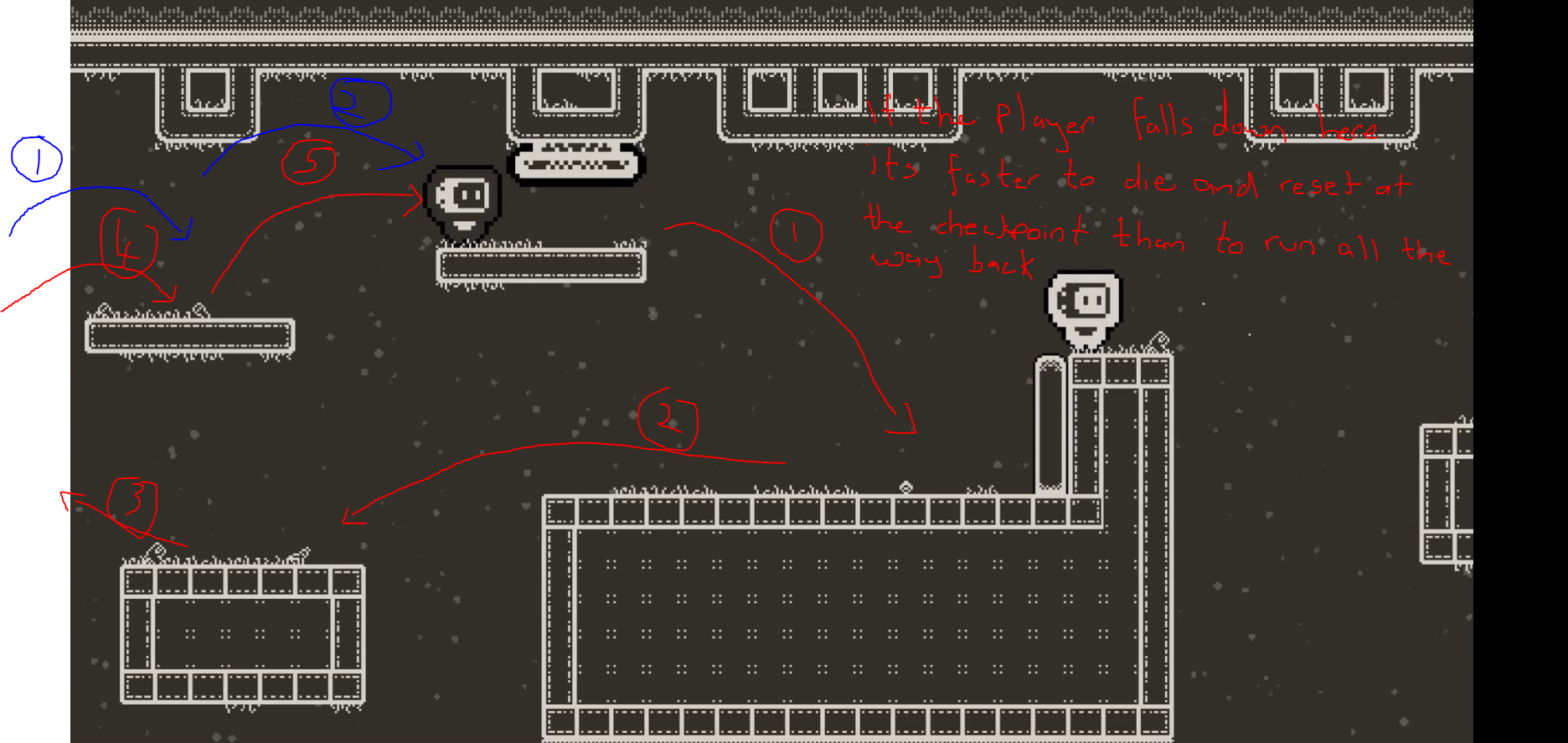
Shown above, there is a button that one player triggers with their head to raise a platform. If the player then falls and misses the platform that has been raised, it is quicker to intentionally die than to backtrack through the level. That feels like something worth looking at, because when deliberately dying becomes the more efficient traversal option, the recovery route probably has too much friction.
Level 6 then introduces what I thought was the most interesting mechanical change in the demo by flipping one player's level upside down. I really liked the concept. My colleague found navigating upside down difficult but really entertaining, and after a number of failed attempts I would sometimes deliberately die so that I became the flipped player instead. That was another situation where the role switching after death worked really well. The level was noticeably harder than the others because the challenge wasn't simply making the same jumps again; one of us was now having to interpret movement and space differently. My colleague actually said Level 6 was her favourite, which was interesting given that it was also the level she struggled with most.
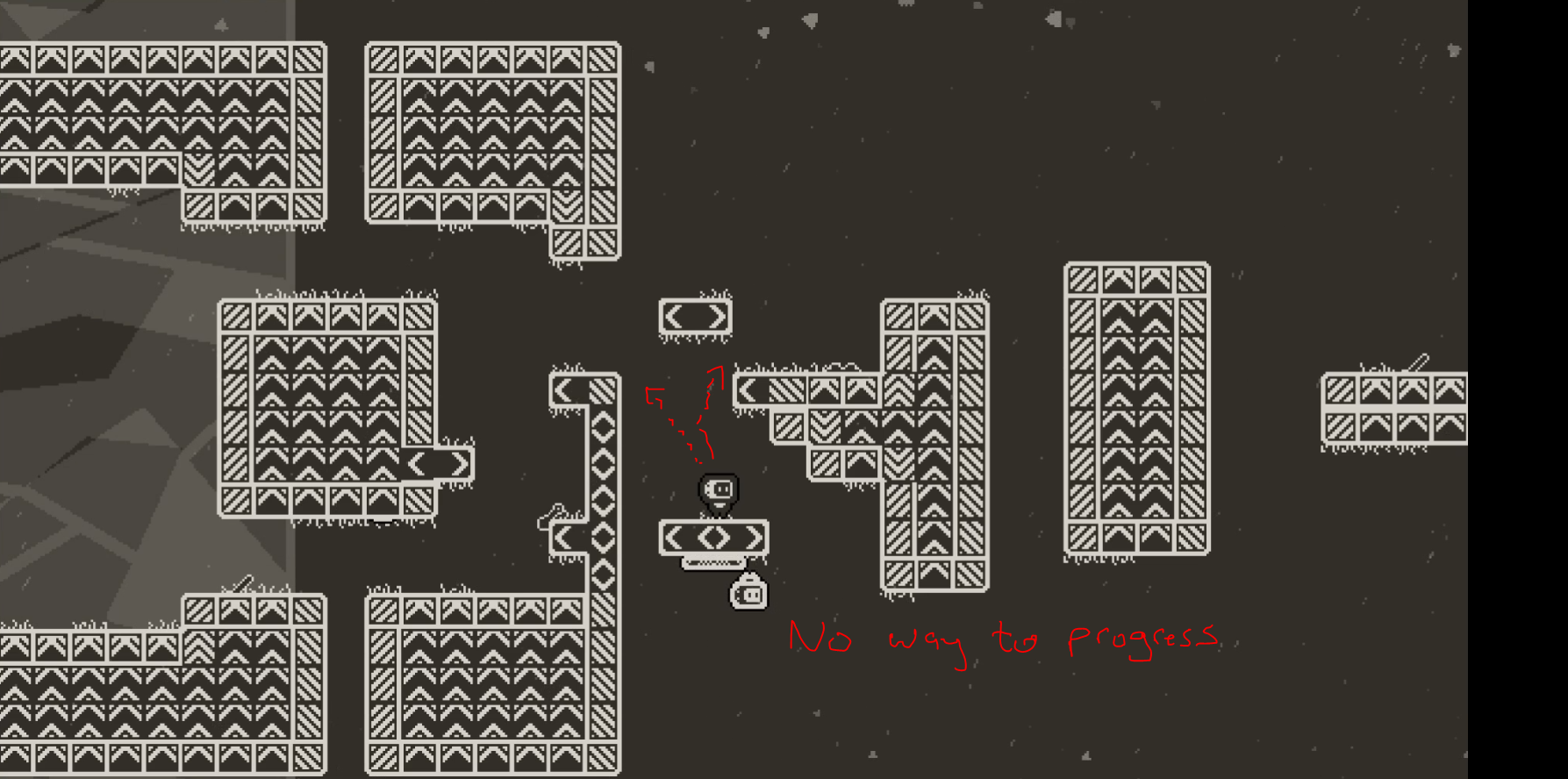
In the screenshot above, it shows another deadlock on Level 6. I do understand that it's in part a puzzle game, so of course you want players to need to think. I just don't know if you intentionally want players to end up in a situation where you want them to have to die, to reset in order to progress.
Puzzle Difficulty
The puzzles themselves were extremely easy. Across the six levels the puzzle difficulty definitely doesn't rise beyond very easy, and there were very few occasions where we stopped because we couldn't work out the intended solution, or because we had to chat and try to determine next steps. The difficulty came much more from executing jumps, so we could understand what we needed to do almost immediately and then still die multiple times trying to actually do it.
For us, that balance worked well because failure was entertaining rather than frustrating, but I would still be conscious of the distinction as the game progresses. At the moment execution difficulty is doing considerably more work than puzzle complexity. At the end of Level 3, you showed that the existing mechanics can support a slightly more layered puzzle and I would have liked the subsequent levels to build from that rather than primarily introducing one new mechanic at a time and then giving us fairly straightforward applications of it.
The first jump in Level 5 (for us) is a prime example of why the low puzzle difficulty didn't stop us enjoying ourselves. Before the power cut, we died so many times attempting what is ultimately just moving right and jumping that we were laughing hard enough to have tears running down our faces. You can even see in the footage provided, that we still failed a few times on the second playthrough. We knew exactly what we needed to do; we just kept getting the execution wrong.
The failure state became part of the entertainment though, and it was helped enormously by how quickly the game reloads after death. Your reloads after death are incredibly fast, so there is literally zero friction on death. If every one of those failures had involved several seconds of waiting, I suspect the exact same jump could have become frustrating very quickly. Instead, we were almost immediately back for another attempt.
Movement
There were a few occasions where the visuals didn’t perfectly match what the character was actually capable of doing.
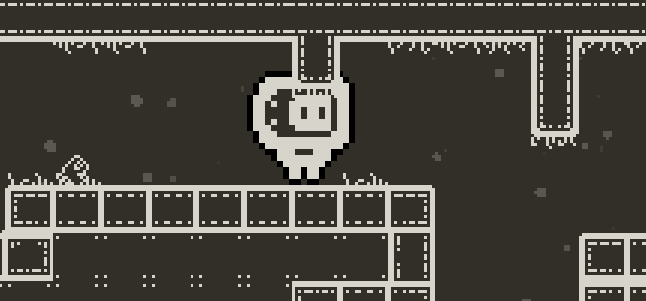
As highlighted above, the larger character moving through gaps that visually looked too small for them is just that bit visually offputting. Looking at the sprite and the surrounding environment, my immediate assumption was that the character couldn't fit, but they then could. It's a very minor thing, but as it's visual, it's immediately noticeable.
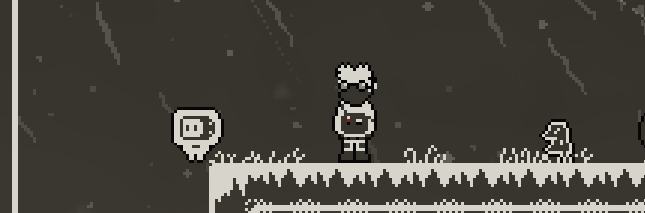
There is a similar issue around ledges. You can be quite forgiving with platforming collisions, and I actually think that's the right decision for this game, but there were points where almost the entire character could visually be standing beyond the edge of a platform without falling. At that point the collision tolerance is so much so that it's visually noticeable (I first noticed this on the first jump after speaking to the engineer the second time on Level 2). I wouldn't want the opposite extreme where every jump suddenly requires pixel-perfect positioning because the forgiving platforming suits the experience, but I do think the visual position of the character and the actual collision boundary could match slightly more closely.
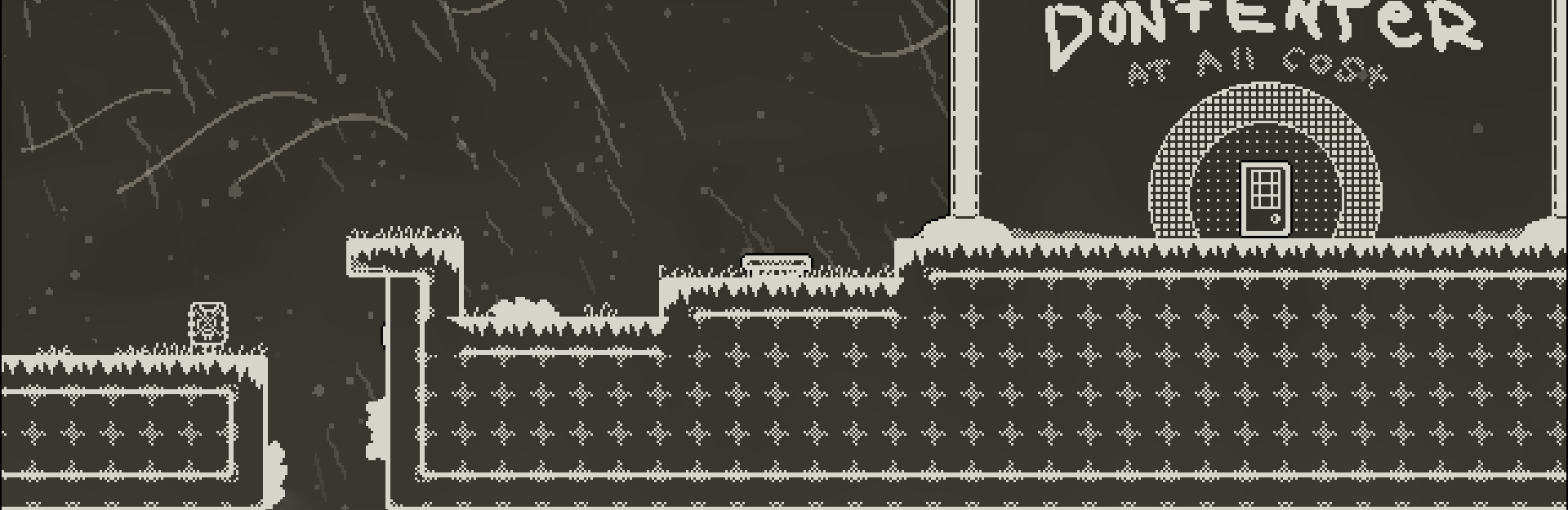
There is also an issue when the two players separate far enough horizontally that both character sprites can actually move off-screen. I would consider preventing the players themselves from disappearing completely beyond the visible camera bounds, or if you need to, perhaps temporarily add back on the player name indicators that you use at the start of the level.
Level Design
Even though the levels were simple, we enjoyed moving through them. Given they are the opening levels of the game, they’re quite easy, but the ambiance and layout were still enjoyable. There were a few places where the level design or signposting could potentially be improved. In Level 5, after going through the vertical barrier/door, we completely missed the vertical button you need to walk into and ended up stuck for a minute or two before noticing it. We had both actually assumed it was a trap that would push us back into the gap, despite traps not being something that had been introduced.
At the end of that level, at the elevator we were stuck for about a minute or so as it wasn't immediately obvious (because previous interactions to end the level) that we needed to hold rather than press DOWN. Neither issue stopped us for particularly long, but they're examples where the affordance or signposting of an interaction could be clearer.
The teamwork sign mentioned earlier is another example of this. Level 1 explicitly establishes a visual sign for cooperative interactions, and then that sign never appears again.
At the beginning of each level, I also think the character indicator should remain visible until the characters have properly left the entrance. My colleague got momentarily confused about which character she was controlling at the beginning of Level 6 because the indicator disappeared before the character was clearly visible and the controls had been inverted, so she didn't initially notice that the character was moving the wrong way. As somebody who plays games regularly, I probably wouldn't have thought much about this myself, but her reaction is useful because she doesn't have that experience. The indicator is already solving a player-orientation problem, so keeping it visible for slightly longer would make the beginning of the level clearer without really adding any clutter.
Menus
The controller navigation was probably the weakest usability area for me. Trying to navigate the menus with the Xbox controllers became confusing enough that I eventually gave up and used the mouse. It feels as if simple directional pushes like left and right are not responding.
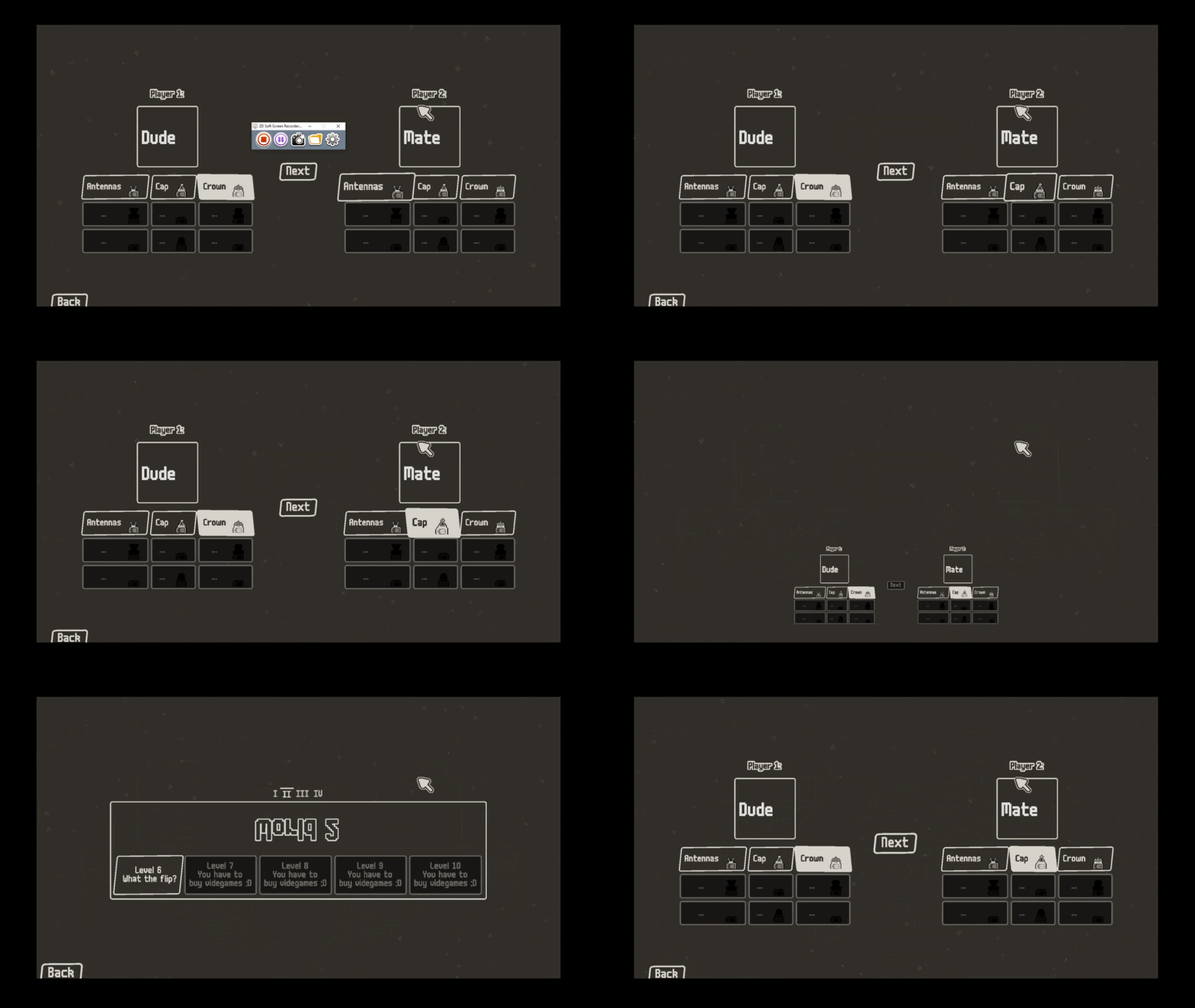
Going from player select to level select doesn't select a level by default, which immediately makes the next expected action less clear than it needs to be, and the selection itself wasn't always visually obvious enough for me to confidently know what pressing A was going to do.
At the end of Level 5, we went through the elevator and returned to the flipped level-select screen and BACK was selected by default, but the selection was extremely difficult to see. I assumed LEVEL 6 : WHAT THE FLIP was selected and pressed A, only to be taken to the character unlockables menu instead. I then pressed NEXT to return to the level select and BACK was selected again. It’s a bit odd for BACK to have the default focus there. If I've just completed Level 5 and Level 6 is now available, my expected next action is actually to just continue to Level 6, but if you need to return to the level select, it would be ideal to have the next sequential level selected by default and ready to be picked.
There are a few other menu behaviours I noticed as well. Both players can enter exactly the same player name, which I assume probably isn't intended. The ability to enter a custom name is a nice little touch in itself.
Selecting RESET SAVE also closes the game, which while I somewhat understand, I don’t think is a good user experience. I don't think the player should need to completely relaunch the game simply because they cleared their save data.
The menu itself looks very nice visually. It’s very legible (perhaps with the exception of the flipped title part). I liked the artwork for the hat unlockables, and the hats are a nice little cosmetic reward too. My only real problems with the menu are with navigating the UI rather than its visual presentation, which is really beautiful, and perfectly cohesive with the visuals in-game.
I will briefly add that having both players be able to control the one cursor during the menus didn’t cause any issues for us, but it is an unexpected choice, and one that caused a moment of confusion on our first playthrough as I didn't realise the other playtester was flicking the joystick while waiting.
Level Replay
As I’ve mentioned above, midway through Level 4, our street had a power outage, so we lost our original footage up to that point. We wanted to replay Levels 1-4 so that we could replace the footage we'd lost, but selecting a previously completed level didn't start that level again. Instead, it loaded us at the checkpoint near the end. If I deliberately select Level 1 again, my assumption is that I'm asking to play Level 1 again rather than resume from the last checkpoint I reached within it. The current checkpoint persistence makes properly replaying completed levels difficult, though I assume this is a bug. I ultimately removed the save data so that we could replay the earlier content, but that shouldn't really be necessary just to start an already completed level again.
Deaths
There is a bug with the death counter in Level 1. We had died twice, but the end-of-level display showed 0 deaths. Deaths did register later in Level 2, so the counter itself does work, but it didn't correctly record what happened during Level 1.
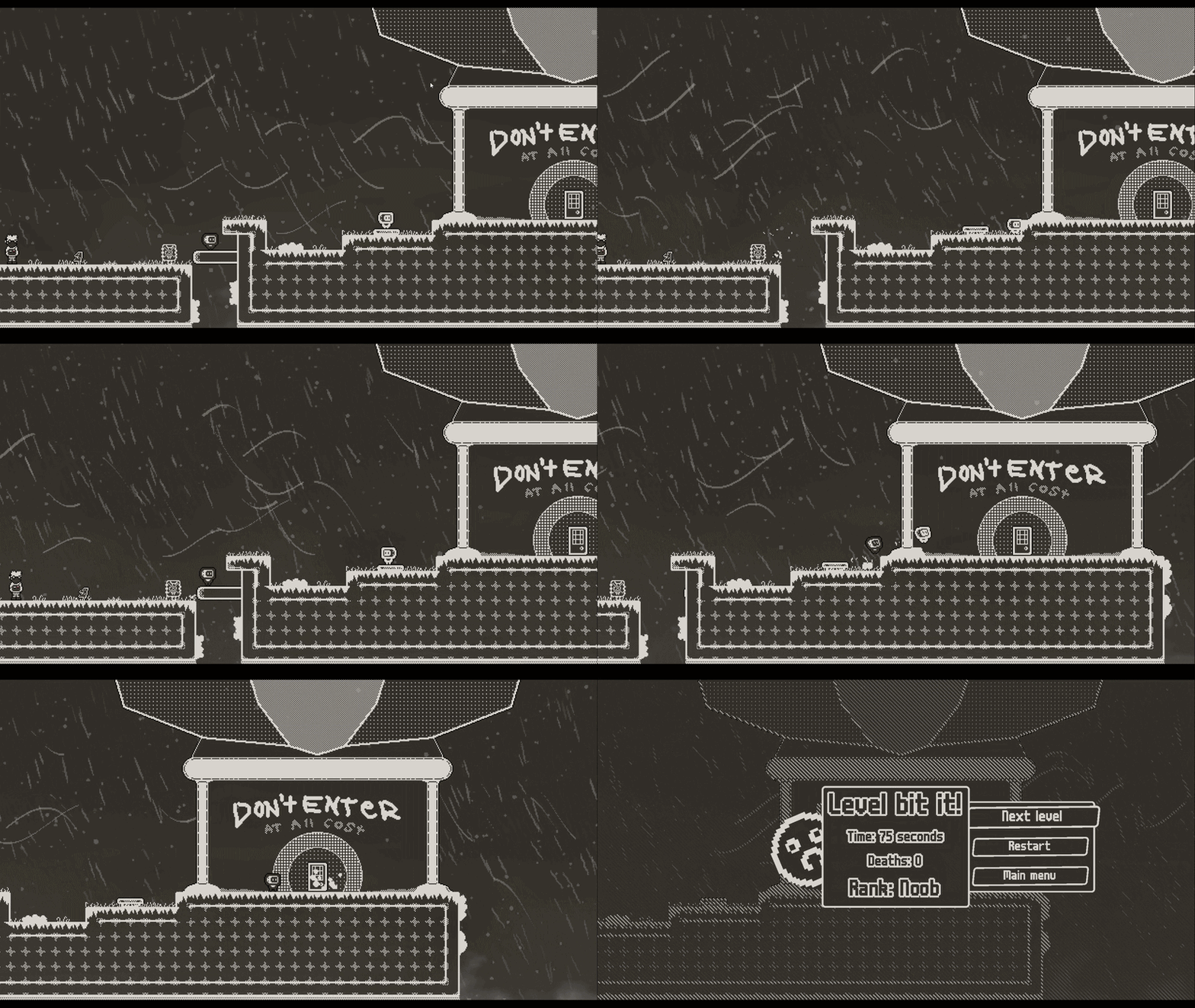
The way deaths work in the wider game, however, is one of the things I think works so well in Bit It. Restarting is extremely quick, which is a major reason our repeated failures didn't become irritating. The mechanic where player roles switch after death is a brilliant addition. We had a lot of fun because of this.
Dialogue
Neither of us particularly liked the engineer or the female dialogue character, and more importantly, neither of us felt they were adding much to the experience. After we'd finished playing, I deliberately asked my colleague if she could tell me anything the engineer had said during the game and she couldn't remember a single thing. I think that's quite useful evidence because the dialogue isn't something happening harmlessly in the background. When it appears, the game stops all player control until you've gone through it, meaning every conversation is actively interrupting the pacing of the gameplay. In Level 1 in particular, the engineer interrupts the gameplay twice, and adds nothing of value.
Both of us came away feeling that the engineer interruptions weren't adding anything for us. The actual co-op gameplay has a nice rhythm when you're moving, failing, retrying and figuring things out together, and then that rhythm stops completely for dialogue that neither of us found particularly engaging. After we finished the game, I played through it a second time, and read everything the engineer says more carefully. I don't think there is a single important sentence they say. Maybe they become more relevant as the game progresses, but they have no importance in the demo, and serve only to interrupt gameplay.
In Level 4 the engineer says that he won't be going forward, but he is physically present again in Level 5. Walking up to him in Level 5 doesn't trigger dialogue despite that being the established behaviour.
Based purely on these six levels, I think the game would flow better without these interruptions in their current form.
Visuals
I really like the art style. The black-and-white presentation works really well, the level artwork generally looks very nice, and the character animations are probably some of my favourite visual elements. I particularly like the inverted colours for the two characters, the subtle movement in their bodies and the light sway. None of it is overdone, but it gives them a lot more personality than completely static characters would have.
The subtle background animations are beautiful as well. Things like the rain and wind add movement and atmosphere without demanding attention, and they're exactly the kind of small environmental details that make the presentation feel more polished. The menu UI is also pretty nice, particularly the artwork around the hat unlockables.
There are a couple of places where the visual cohesion slips slightly. The DON'T ENTER AT ALL COST section at the end of Level 1 is kind of cool by itself (it's very MS Paint, which I like), but I don't think it fits particularly well with the rest of the aesthetic. Most of the visual design uses very clean, straight lines, whereas this looks like it belongs to something slightly different. It's amplified by the fact your overall art direction is incredibly tight.
The character portraits are beautiful. The slight sway to them as they are on screen is minor, but adds a nice touch of polish. Even though I didn't think the characters themselves (the engineer, and the woman) had any place in the demo, their portraits are awesome. The engineer's sprite is also very nice, though my colleague apparently didn't share my interpretation of the character design because she spent the playtest referring to him as “the sheep” (which admittedly, I can sort of see)
Game Feel
There is an awful lot we both liked here, in terms of both large and small details. The character movement and animation feel really nice, and the subtle camera shake when landing from height works particularly well. It's nice to have the option to turn this off in the settings too, though we chose to leave it on. It isn't excessive, and it gives the landing a little more weight and is a nice piece of game-feel feedback. Movement in general also feels to be really nicely tuned, which is evident by how quickly my colleague was able to get comfortable with the controls. The acceleration as you move while you’re large is a brilliant touch. That key detail is what contributed to about 75% of our deaths, but it felt really good.
There are also some really nice smaller touches throughout the game, such as the button sounds on the menus, which suited the mood and made interactions feel satisfying. Little environmental details such as the little objects that bounce as you move past, the particle effects as you run, give the whole thing a level of polish that for us made Bit It feel quite aesthetically complete.
The little door-opening animation at the beginning of a level is also a nice idea, but I think it's currently almost too subtle. You begin the level partially obscured and then enter the playable space with very little visual or audio emphasis. The animation is there, but it's so understated that the beginning of the level feels slightly odd or underwhelming. I don't think it needs a dramatic transition, but slightly stronger feedback around the door opening or the characters entering could make the start of each level feel more deliberate.
I also think keeping the movement forgiving was the right decision. As mentioned earlier, the collision can be visually too generous around some ledges, but I wouldn't want that corrected by making the platforming substantially less forgiving. Part of the reason repeated failure worked so well for us was that the game didn't make every mistake feel punishing.
Audio
The music generally fits the vibe really well, although Level 6 was the exception IMO because I thought the music represented quite a significant tonal shift and felt out of place compared with what we'd heard previously. That said, my colleague completely disagreed with me. She really liked the Level 6 music and specifically described it as uplifting, so apologies for giving two immediately conflicting bits of feedback on this. I found the change inconsistent with the tone from the previous levels, while she just loved that particular Level 6 score.
Text
There are quite a few spelling and grammatical errors throughout the current build. I've included screenshots showing examples, but this isn’t exhaustive. I won't list every typo individually here because the screenshots show the specific examples, but I think the game needs a proper proofreading pass before release. I’m not referring to slang or choice to spell words like “you” as “u”, those are choices and not mistakes per se.
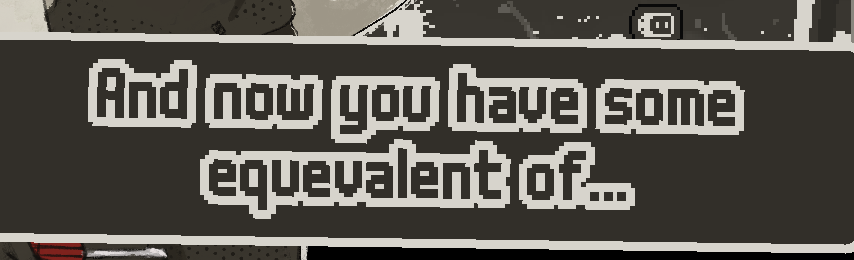
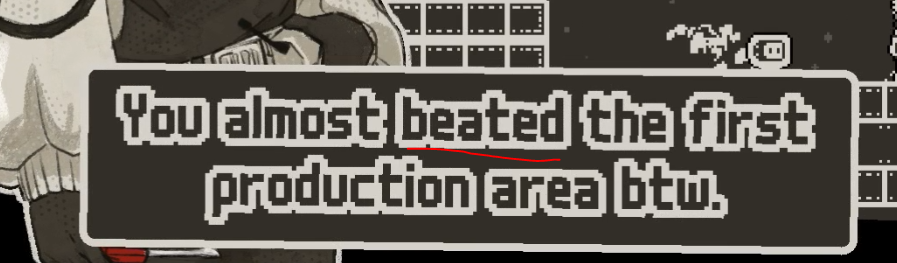
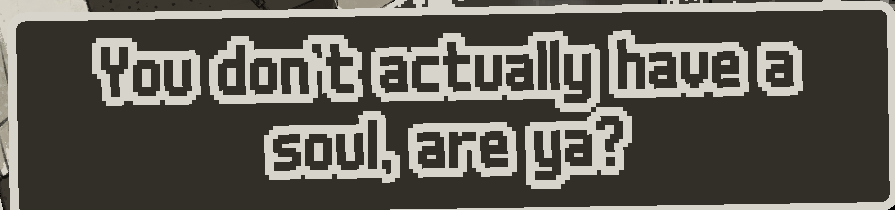
The tone of some of the engineer's dialogue also wasn't always particularly clear to me, and part of the reason we didn't find that character engaging.
Demo Ending
The ending of the demo needs to be much clearer. After completing Level 6, the game loops back to Level 1 and neither of us immediately realised that we'd finished the available content. There isn't enough completion feedback to tell the player that they've reached the end of the demo, so rather than feeling like we'd completed something, it felt as though we'd suddenly been sent back to the beginning.
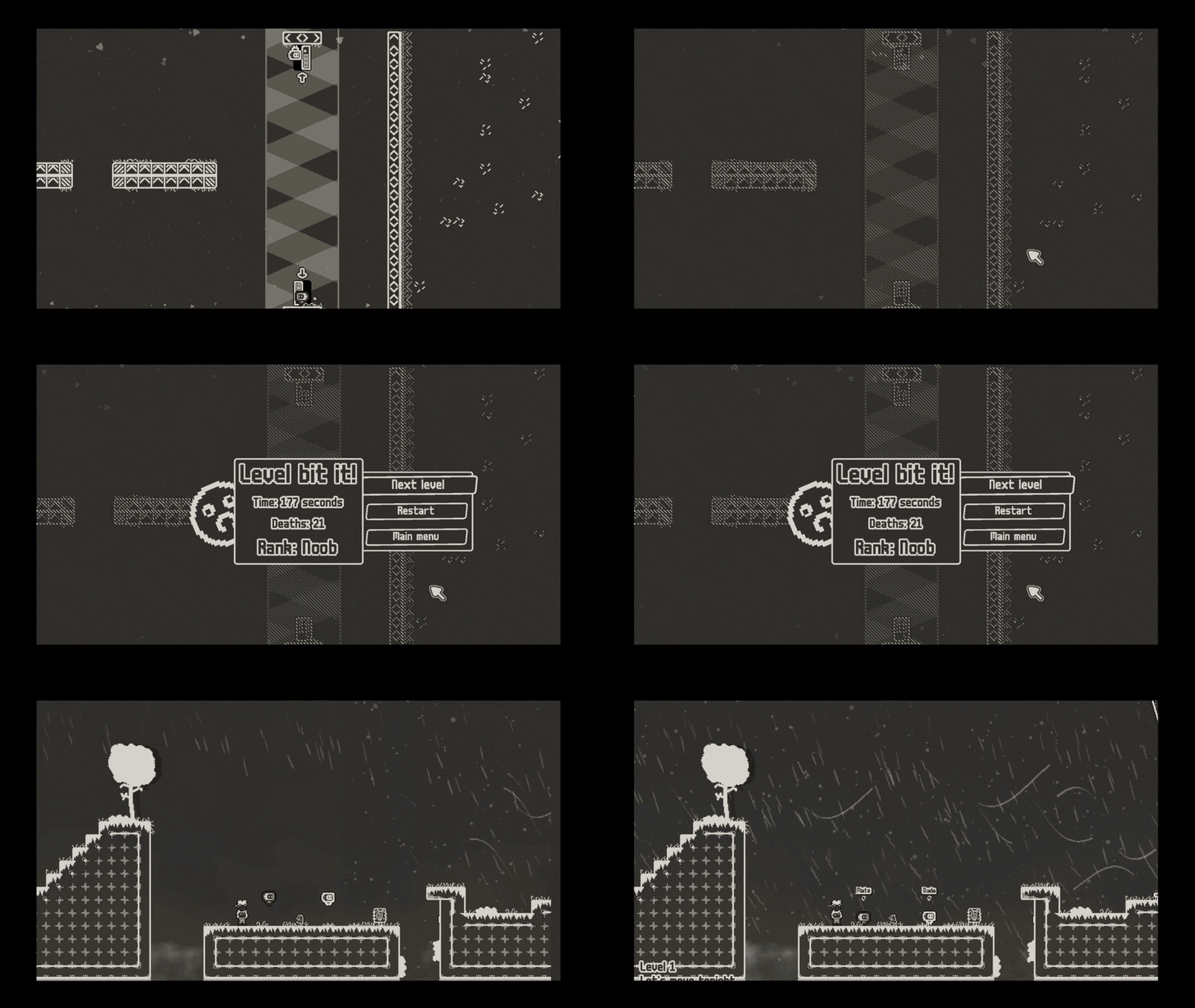
It’s an important moment to mark as the player has just completed everything the demo has to offer. Even a simple end-of-demo screen would make a big difference and give the experience some closure, and give you a good opportunity to ask for a wishlist. At the moment, the demo ends very abruptly and doesn't make enough of the fact that the player has reached the end.
Miscellaneous
Pressing DOWN to enter the door at the end of a level felt unintuitive. My instinct was that UP would be the natural input for entering a doorway, and I repeatedly found DOWN slightly strange. There is nothing inherently wrong with using DOWN, but it didn't match my immediate expectation from what I was seeing on screen. My colleague had no thoughts on this.
Final Thoughts
I came away from BIT IT feeling quite positive about it. There is obviously work still to do, but the important thing for me is that the core experience already worked. We sat down together for around an hour, laughed quite a lot, finished the demo, and my colleague was willing to play it with me again should we choose to do so.
I think the biggest question for me going forward is how much further the game can push what it already has, though judging by the videos on the Steam page, there is quite a bit more the game has to offer. The demo introduces several mechanics that I liked, but I finished it wanting to see puzzles with more steps that would require a bit more thought and cooperation.
Ultimately, I enjoyed my hour with it, and more importantly, so did someone who would ordinarily have very little interest in sitting down to play games at all, let alone a co-op platformer. That is probably the strongest endorsement I can give the core experience.
If you have any questions, please let me know.
Stephen Long
Indie Game Booster Ltd
stephen@indiegamebooster.com